
Why we built our civic AI intelligence layer, and what general-purpose tools can't give you
The headlines have moved on. A few years ago, the question was whether AI would change campaigns. That question is settled. The overwhelming majority of political consultants now use AI tools at least weekly. AI is in the writers’ room, the war room, and the donor call sheet.
What hasn’t kept pace are the AI chatbots themselves. The AI tools civic leaders are reaching for—ChatGPT, Claude, Gemini—are powerful, but they were built for the general public. They were not built for a candidate trying to understand a county zoning fight, a city councilor staring down a budget vote, or an advocacy group in the last week of a ballot initiative. And when general-purpose AI gets pulled into civic work without the right grounding, it fails in three predictable ways.
The Sycophant Effect
Modern AI assistants are trained to be helpful, which most of the time means trained to be agreeable. Ask whether your message is landing, and the model will tell you it’s strong. Ask whether your opponent’s attack is working, and it will tell you not to worry. Models are tuned to make users feel good so that usage continues, not to give users the bracing read they actually need. For a leader with hours to decide whether to engage on a developing local issue, an AI that flatters their instincts is worse than no AI at all.
The Averaging Effect
Every general-purpose model is, in effect, the average of the internet. Ask one to draft a stump speech and you get the median version of every stump speech ever written. That is a real problem in a profession where differentiation is the entire game. If every campaign in the state is reaching for the same model with the same prompts, the messaging converges. Voters notice generic AI prose faster than you’d expect, and the leader who needed to sound like themselves ends up sounding like everyone else.
The Hallucination Effect
Models invent. They invent quotes, statistics, vote records, and bills that don’t exist, with the same confident tone they use for things that are real. In a context where a single fabricated detail can become a forty-eight-hour news cycle, this is a structural risk. The model doesn’t know what it doesn’t know, and it doesn’t know your district and the key data sources in your region. Like the saying, “garbage in; garbage out,” insights are only as good as the quality and curation of the research data that informs them.
What's Actually Missing
What an AI chatbot lacks isn’t intelligence. It lacks context. It doesn’t know who the leader is, what they have said before, what their district cares about today, who their stakeholders are, or what the rules are in their state. It can’t see the local Facebook group where a school-board fight is metastasizing, or the comment thread under a TikTok video that just hit two hundred thousand views in three counties. It starts every conversation from zero.
That is the gap Smart Messaging Engine was built to close.
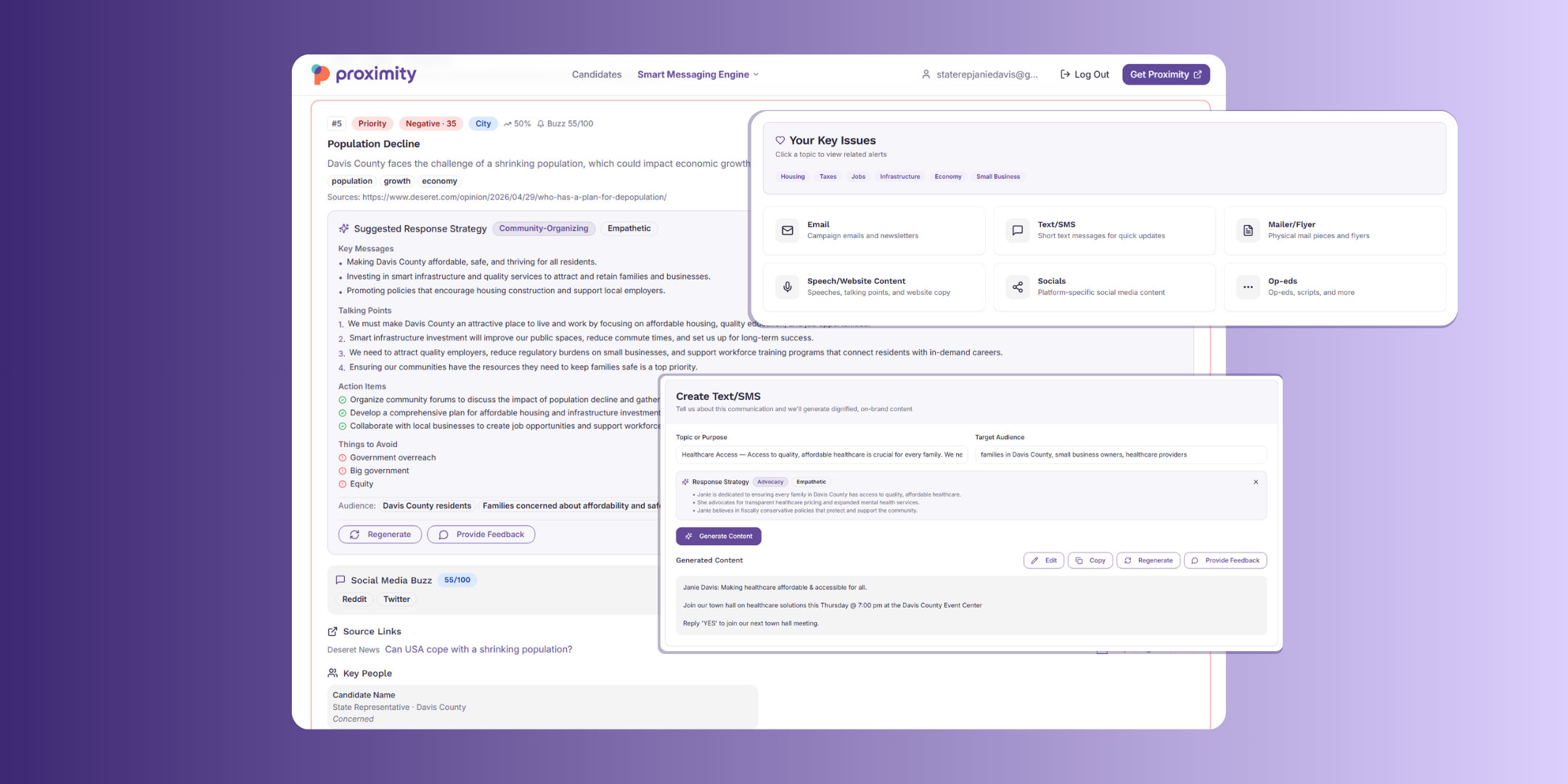
Smart Messaging Engine is built specifically for civic and political leaders. It listens continuously across news, social platforms, and community conversations in a leader’s district. It carries a leader profile shaped by their biography, priority issues, vocabulary, and trusted sources, so every recommendation sounds like them, not like the average of the internet. And it is grounded in what is actually happening on the ground today.
The result is the kind of capability that, until now, only the best-funded campaigns in the country could afford: a continuous, district-level intelligence layer that flags shifts in sentiment, surfaces emerging issues, and recommends specific next steps. Until now, that kind of capability was reserved for presidential races, statewide campaigns with serious money, and a handful of deep-pocketed organizations.
Why This Moment Matters
Democratizing access to civic AI represents a genuine shift in what the math allows. Now the cost of being out of touch with your district is no longer a budget question. A school-board candidate, a city councilor, a state-house challenger, a nonprofit running an issue campaign—all of them had to fly blind because competitive intelligence was far too expensive. Now any leader has the kind of intelligence that the best-resourced operatives have been using for years.
So why now? Because AI has already arrived in politics, and the version of it that is reaching civic leaders today is not built for them. The sycophancy, the averaging, the hallucinations are not bugs to be patched in next year’s model. They are the predictable behavior of tools designed to serve the general public.
Civic and political leaders, and the communities they represent, deserve better than the average of the internet. Politics is about people. Messaging only works when it sounds like the leader saying it, on an issue they actually believe in. Smart Messaging Engine is what better looks like.